
Review the artwork and its evidence together
A label review needs the actual artwork. A typed ingredient list in an email does not show whether the bottle, carton and leaflet carry the intended information, or whether the printed text can be read. Begin by identifying the product, specification revision, packaging components and Ireland/EU sales destination.
HPRA labelling guidance points to Article 19 and summarises areas including the Responsible Person address, contents, durability information, precautions, batch reference, function and ingredients. For Ireland it describes English, or Irish and English, labelling. Treat that summary as a starting point for the current provision and its conditions, rather than a universal checklist.
Work from a controlled copy
Give each panel an identifier, such as bottle-front-v3 or carton-side-v2. Retain the artwork PDF and a photograph or proof at the intended size. Record which product specification and packaging choice the copy describes. A reviewer should be able to reproduce the exact view that led to a finding.
Use the annotated synthetic panel in the working files to see the review method. Its placeholders are deliberately incomplete. It is not usable retail artwork.
Synthetic Product A: three questions on one panel
Product A is a fictional face oil. Artwork revision 3 shows a product name, a proposed volume, a batch placeholder, a proposed durability symbol and an unfinished ingredient line. No real formulation or Responsible Person has been supplied.
First, the proposed address has no linked role decision. Record the artwork location, the role evidence needed and an owner to obtain it. Do not infer the Responsible Person from the company printing the label.
Second, the proposed durability statement has no linked assessment evidence. Keep the choice unresolved. A symbol taken from another product is not a supported value for Product A. HPRA explains that durability and period-after-opening information need supporting safety-report evidence.
Third, the ingredient line is incomplete. Ask for the current specification and the relevant ingredient-labelling review. Alphabetising supplier names, copying an older artwork or relying on a fragrance trade name would not resolve that question. Fragrance-allergen changes need their own current Annex III review.
Separate the findings
For each question, distinguish text present, evidence located, specialist finding and correction completed. A designer can confirm that a requested line was inserted without deciding whether the line is legally sufficient. A specialist can identify the required correction while the artwork remains unchanged.
After a correction, retain the old artwork and compare the new revision against the agreed finding. Record the review scope and any unresolved packaging or language questions. The latest file name alone should not decide which copy is approved for printing.
Keep market scope explicit
This worked example concerns Ireland/EU. Great Britain and Northern Ireland require separate scope checks and their own authority routes. T04 provides separate review files. The final output is a traceable artwork review with evidence and decisions, rather than a generic label marked compliant because all rows contain text.
Sources and legal dates
HPRA: Article 19 labelling guidance and durability evidence; exact current provisions and exceptions need specialist verification
Ireland / EU · Version: Live official guidance retrieved 16 October 2026 · Retrieved: 2026-10-16 · Legal effective date: See the legal-date basis below
Source type: Official guidance
Retrieval date is not the legal application date. The complete current legal text has not been specialist-verified.
Check the actual packaging, language, product type and current Annex III separately.
European Commission: Fragrance-allergen guidance: Regulation (EU) 2023/1545, Annex III, placing-on-market and subsequent supply transitions
EU; NI applicability requires separate verification; no assumed GB equivalence · Version: Live official guidance retrieved 16 October 2026, including the already-passed July 2026 transition · Retrieved: 2026-10-16 · Legal effective date: See the legal-date basis below
Source type: Official guidance
Guidance dates do not replace the exact Regulation 2023/1545 provisions. EUR-Lex HTML and PDF retrieval returned browser challenges; full legislation was not retrieved or verified.
Guidance identifies 31 July 2026 and 31 July 2028 for distinct events. Exact statutory conditions, current Annex III and each stock group's evidence require specialist review.
Related next steps
Reviewed downloads
Annotated fictional label questions
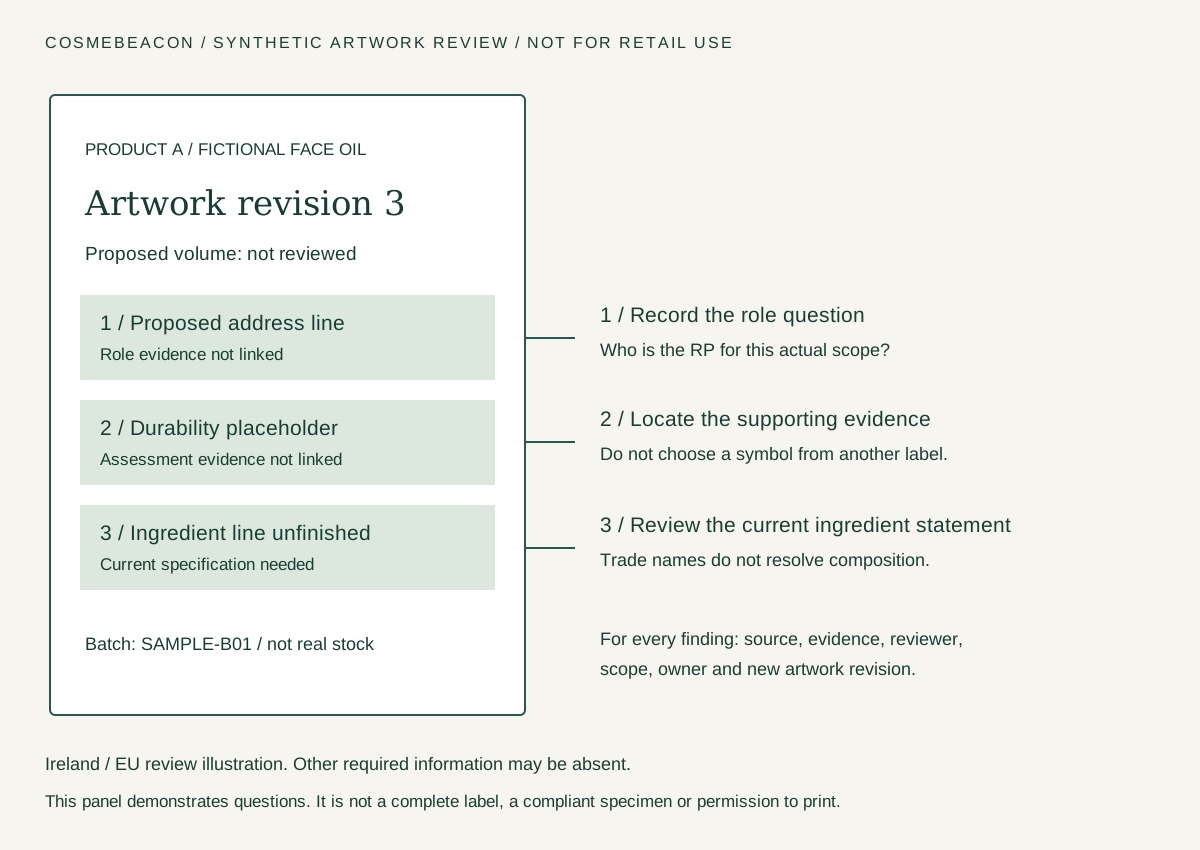
Diagram · Page revision 2 · 3 KB
Download synthetic-label-review.svg ↓